A UPC-A barcode has 12 digits: a GS1 company prefix that identifies the brand owner, an item reference for the specific product, and a final check digit that catches scanning errors. The same product has the same UPC everywhere, which is why barcodes are perfect for price comparison. The first digits don't tell you where a product was made.
The anatomy of a UPC
| Part | What it is |
|---|---|
| Company prefix first 6–10 digits | Assigned by GS1 to the brand owner |
| Item reference | Chosen by the brand for each product, size and variant |
| Check digit last digit | Calculated from the other 11 to catch errors |
Because the company prefix can be different lengths, there's no fixed split between the company part and the item part. What matters for shoppers: every size, flavor and variant gets its own number, so matching barcodes means identical products.
What the first digit usually tells you
| First digit | Typically used for |
|---|---|
| 0, 1, 6, 7, 8 | Regular products |
| 2 | Random-weight items priced in store (meat, deli, cheese) |
| 3 | Drugs and health products (often based on the National Drug Code) |
| 4 | In-store use, like store-specific codes and loyalty cards |
| 5 | Coupons |
That's why store-printed weight labels (starting with 2) and in-store codes (starting with 4) can't be compared across stores. They aren't product-specific.
How the check digit works
The check digit lets the scanner catch misreads. For the UPC 03600029145?:
- Add the digits in odd positions (1st, 3rd, 5th…): 0+6+0+2+1+5 = 14. Multiply by 3 = 42.
- Add the digits in even positions: 3+0+0+9+4 = 16.
- Add them: 42 + 16 = 58.
- The check digit is what brings that up to the next multiple of 10: 2. So the full UPC is 036000291452.
If a scanner reads a digit wrong, the math usually won't work out and the scan is rejected instead of ringing up the wrong item.
Myth: the prefix shows where it was made
You may have read that barcodes starting with certain numbers mean a product was made in a certain country. According to GS1, that's not true. The prefix shows which GS1 organization issued the number, not where the product was manufactured. To find the country of origin, check the label.
UPC vs. EAN
EAN-13 barcodes, used in most countries outside North America, have 13 digits. A 12-digit UPC can be written as an EAN-13 with a leading zero, so good scanners treat them as the same product. More in how barcode price comparison works.
- Scan the barcode of the item on the shelf with Price Match Paradise. No account needed to start.
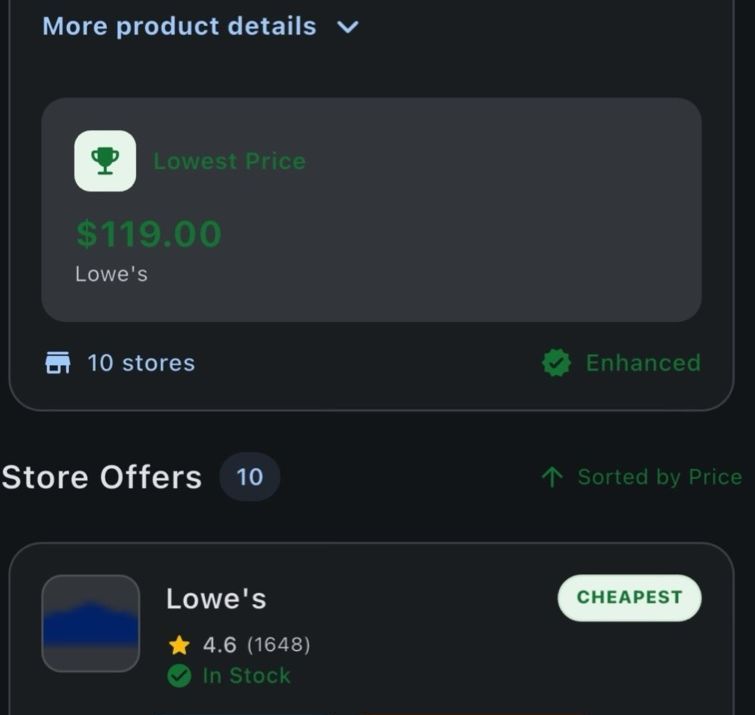
- Review matching offers across supported retailer sources, with stock status and price-match guidance when the retailer data is available.
- Decide in the aisle: ask for a match, buy it here because it's already the best price, or pick it up where it's cheaper.
FAQ
What do the numbers on a UPC barcode mean?
A UPC has a GS1 company prefix identifying the brand owner, an item reference for the specific product, and a final check digit that catches scanning errors.
Does a barcode show the country of origin?
No. According to GS1, the prefix shows which GS1 organization issued the number, not where the product was made. Check the label for country of origin.
What is the check digit on a barcode?
The last digit, calculated from the other digits. It lets scanners detect misreads so the wrong item doesn't ring up.
Is the same product's UPC the same at every store?
Yes, for the same manufactured product. Store-printed labels and in-store codes are the exceptions.
Scan any UPC. Compare every store.
See the same item at 50+ supported retailer sources in one search. Free to start, no account needed.
Keep reading
Sources: GS1: Does the prefix show country of origin? · GS1 US: UPC barcodes don't reveal where products are made · GS1 Company Prefix. Summary as of September 22, 2026. Policies change and individual stores have discretion, so confirm with the store. Price Match Paradise isn't affiliated with or endorsed by any retailer mentioned.
Price Match Paradise Team
We build the barcode price comparison app that helps shoppers find the lowest price on the item in their hand. Spotted a policy change? Let us know.