To compare prices with a barcode, open a barcode price comparison app, point your phone's camera at the product's barcode, and the app looks up that exact product and shows its price at other stores. It's more accurate than searching by name, because the barcode (UPC or EAN) identifies the exact brand, product and size.
Why scanning beats searching by name
Search "paper towels 12 pack" and you'll get dozens of similar products in different sizes, sheet counts and brands. Comparing them is slow and error-prone. A barcode avoids that problem: it points to one specific product. The same brand, flavor and size carries the same barcode at every store that sells it.
That's also why barcodes are ideal for price matching. Stores only match identical items, and "same barcode" is the clearest proof that two items are identical.
Not sure which app to use? See what to look for in a barcode scanner app.
How product barcodes work (UPC vs. EAN)
| Type | Digits | Where you'll see it |
|---|---|---|
| UPC-A | 12 | Most products in the US and Canada |
| EAN-13 | 13 | Products from most other countries, and many imports |
| UPC-E | 8 (compressed) | Small packages like gum, cans and cosmetics |
| QR code | Varies | Links, coupons and menus. Usually not a product ID |
(Full explanation here.) The first digits of a UPC identify the company that makes the product (assigned by GS1, the global barcode standards body). The next digits identify the specific item, and the last digit is a check digit that catches scanning errors. A UPC-A code can also be written as a 13-digit EAN with a leading zero, so good scanners treat them as the same product.
How to compare prices by scanning (step by step)
- Scan the barcode of the item on the shelf with Price Match Paradise. No account needed to start.
- Review matching offers across supported retailer sources, with stock status and price-match guidance when the retailer data is available.
- Decide in the aisle: ask for a match, buy it here because it's already the best price, or pick it up where it's cheaper.
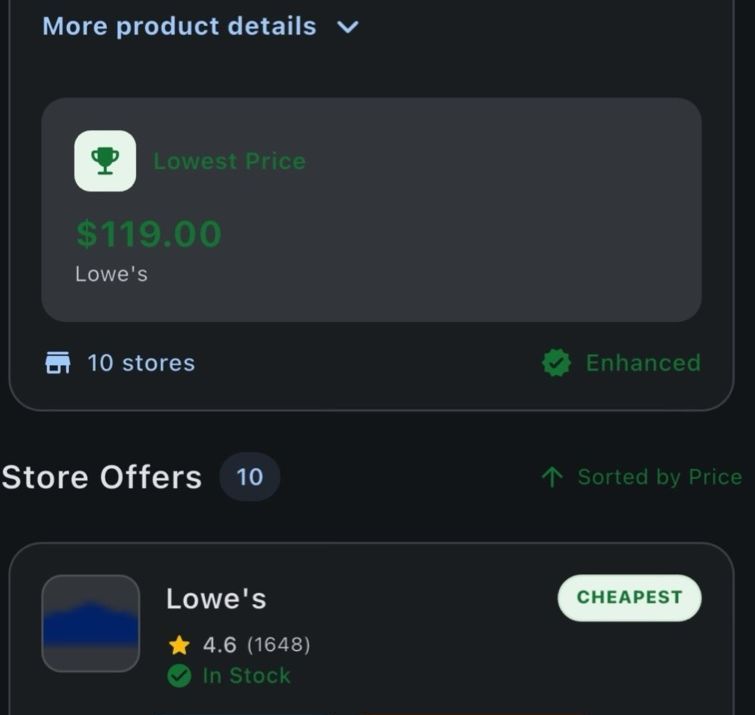
The whole process takes a few seconds, fast enough to do in the aisle before you put something in the cart.
Tips for accurate scans
- Scan the product, not the shelf label. Shelf tags often carry the store's internal code, not the product's UPC.
- Hold steady in good light, about 4 to 8 inches away, with the whole barcode in frame. Curved cans scan better when you tilt them slightly.
- Produce, deli and meat are different. Loose produce uses 4 or 5-digit PLU codes, and weighed items get a store-printed barcode with the price built in. These won't compare across stores, but packaged versions will.
- Watch for multipacks. A 6-pack and a single can have different barcodes. Scan the one you're actually buying.
- Check the unit price. When a store sells a different size, compare price per ounce or per count.
What to do with the result
Once you know the lowest price, you have three good options:
- Ask for a price match if the store you're in matches that competitor. See which stores still do in our price matching guide.
- Buy it here with confidence if this store is already the cheapest, or close enough that the trip isn't worth it.
- Buy it where it's cheaper, especially for expensive items, or add it to the list for your next trip there.
What's most worth scanning?
Anything that is identical everywhere and that you buy often or pay a lot for:
- Diapers, wipes, formula and baby care
- Over-the-counter medicine, vitamins and personal care
- Laundry, cleaning and paper products
- Coffee, snacks and pantry brands
- Small appliances, electronics, tools and toys
FAQ
Can I compare prices by scanning a barcode with my phone?
Yes. A barcode price comparison app uses your phone's camera to read the UPC or EAN code and looks up the same product at other stores. No extra hardware needed.
Is a UPC the same at every store?
For the same manufactured product, yes. The UPC identifies the brand, product and size, so it's the same wherever the item is sold. Store-brand products and store-printed labels for weighed items are the exceptions.
What is the difference between UPC and EAN?
UPC-A has 12 digits and is used mainly in the US and Canada. EAN-13 has 13 digits and is used in most other countries. A UPC can be written as an EAN by adding a leading zero.
Why won't a barcode scan find my product?
The product may be new, regional or a store brand, or you may have scanned a shelf tag or a store-printed label instead of the product's own barcode. Try the barcode printed on the package itself.
Can I use a barcode scan as proof for a price match?
A scan helps you find the identical item and its current price. Stores usually want to see the competitor's current price for that exact item, and a comparison screen or the competitor's live listing on your phone generally works.
Point, scan, pay less.
Scan any barcode and see the same item at 50+ supported retailer sources in one search. Free to start, no account needed.
Keep reading
Sources: GS1 US: UPC barcodes. Summary as of September 22, 2026. Policies change and individual stores have discretion, so confirm with the store. Price Match Paradise isn't affiliated with or endorsed by any retailer mentioned.
Price Match Paradise Team
We build the barcode price comparison app that helps shoppers find the lowest price on the item in their hand. Spotted a policy change? Let us know.